
The Assessor’s Office Does Not Set Tax Levies or Establish Mill Rates
General Information
- It is the duty of the Assessor to make a fair and equitable assessment of all property in El Paso County. Taxes are distributed equally in accordance with the value of each taxpayer’s property.
- The percent of actual value of all residential and multi-family property is determined by the State Legislature.
- For 2026, the assessment rate for residential is 6.8%, commercial is 25% and vacant land is 26%
Understanding Your Assessment
Taxation
- Taxing authorities, such as school districts, park districts and city councils set tax rates and levy taxes
- Taxpayers demand services
- Taxing authorities require money to provide those services
Valuation
- Buyers and sellers in the market create value
- The Assessor’s Office studies the market and collects information about properties to estimate value
The Assessor’s Office has no control over tax rates!
- Attend budget hearings
- Call or write the taxing authorities
- Decide whether you are willing to sacrifice services to keep taxes low
- Work for efficiency in government
- A shortage of detached houses in a desirable city neighborhood can dramatically increase prices
- In a recession, larger homes may stay on the market for a long time, but more affordable homes are in demand, so their prices rise
- In a stable neighborhood, with no extraordinary pressure from the market, inflation may increase property value
- A bedroom, garage, or swimming pool is added, or part of the property is destroyed by flood or fire
- A change in the market
- If a town’s major industry leaves, property values can collapse
- As decaying neighborhoods with good housing stock are discovered by young home buyers, prices gradually rise and then may soar as the neighborhood becomes fashionable.
If Assessed Values Rise, Do Taxes Rise?
Not Necessarily.
- Taxing authorities decide how much money the property tax has to raise each year, say $1 million. Assessors estimate the total assessed value of all taxable property, say $100 million.
- A tax rate is calculated by dividing the amount of tax to be raised by the total assessed value: If your home’s assessed value is $100,000, your tax bill will be:
.01 x $100,000 = $1,000
- If total assessed value doubles to $200 million, and the amount to be raised stays the same, the tax rate will be:
$1,000,000 divided by $200,000,000 = .005 or 1/2 percent
- However, if assessed values increase, and the tax rate remains the same, taxes will rise. The taxing authorities are demanding more money, even though they have not changed the rate:
.01 x $200,000 = $2,000
$1,000,000 divided by $100,000,000 = 1 percent
You will want to know:
- How the Assessor values property
- How to gather information about your property and similar properties
- How the appeals process works and what the deadlines are
It is the responsibility of the property owner to furnish good information about your property to the Assessor.
- Calculate the assessed value (percentage of actual value) of each property
- Prepare the report “Abstract of Assessment,” which is a summary of assessed values by class of property
- Certify values to taxing entities
- Prepare and certify the tax warrant of the entire County to the Treasurer
- Process abatement petitions
- Discover and identify (describe) all property in the County
- Inventory all property including quantity, quality, use, condition, and important characteristics
- List the taxability of each property
- Identify the property classification, including class and subclass
- Estimate the actual value of each property
- Notify owners of the actual value of their property
- Appear and defend not only the value of the property, but also methods used to establish value, upon appeal by the property owner
-
School Property Tax is Established and Levied by the District School Boards
-
County Property Tax is Established and Levied by the County Commissioners
-
City and Town Property Tax is Established and Levied by City and Town Councils
-
Water, Sanitation, Fire, Special Improvement, Metro & Miscellaneous District Property Taxes are Established & Levied by their Respective Boards
2024 Abstract of Assessment
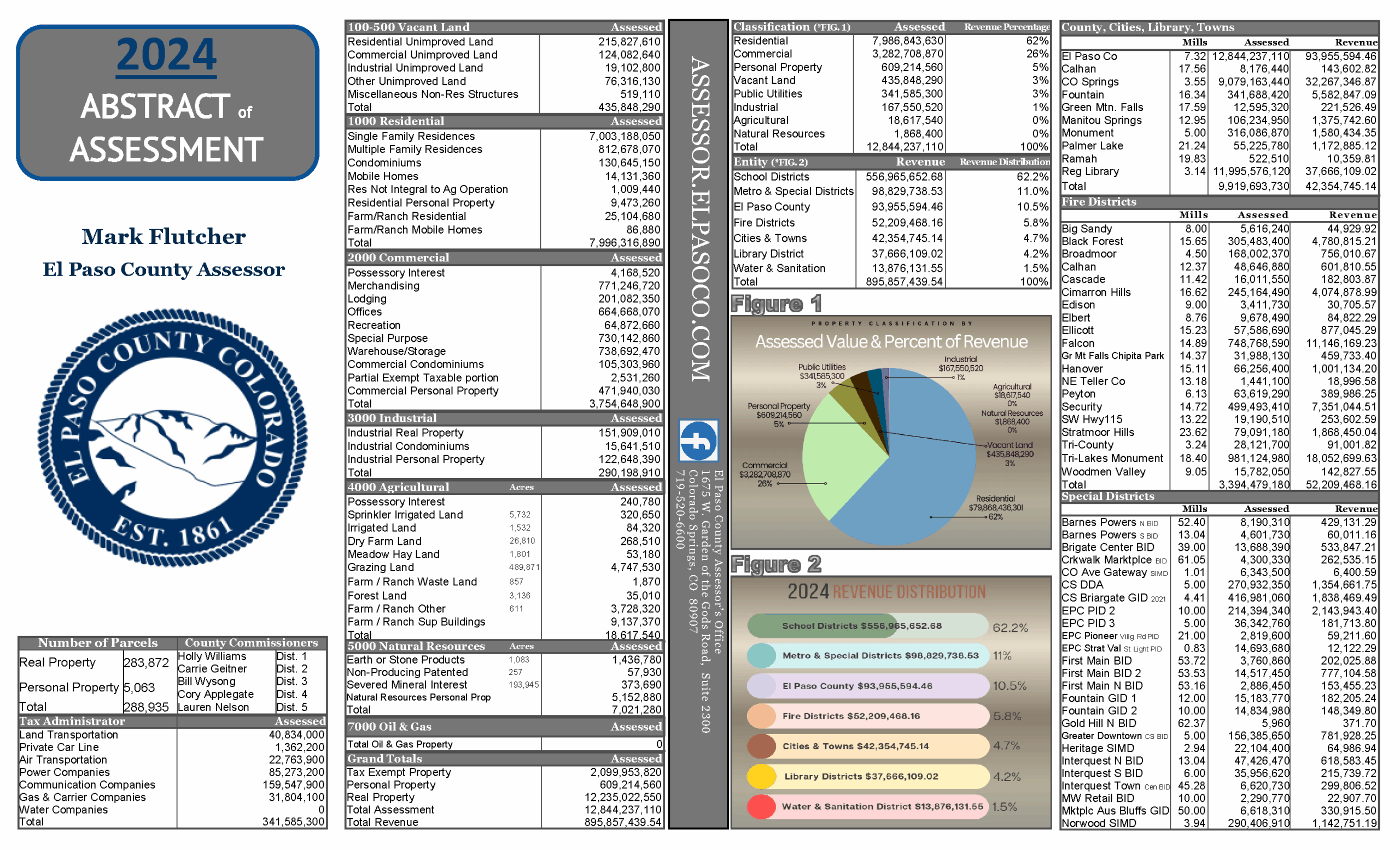
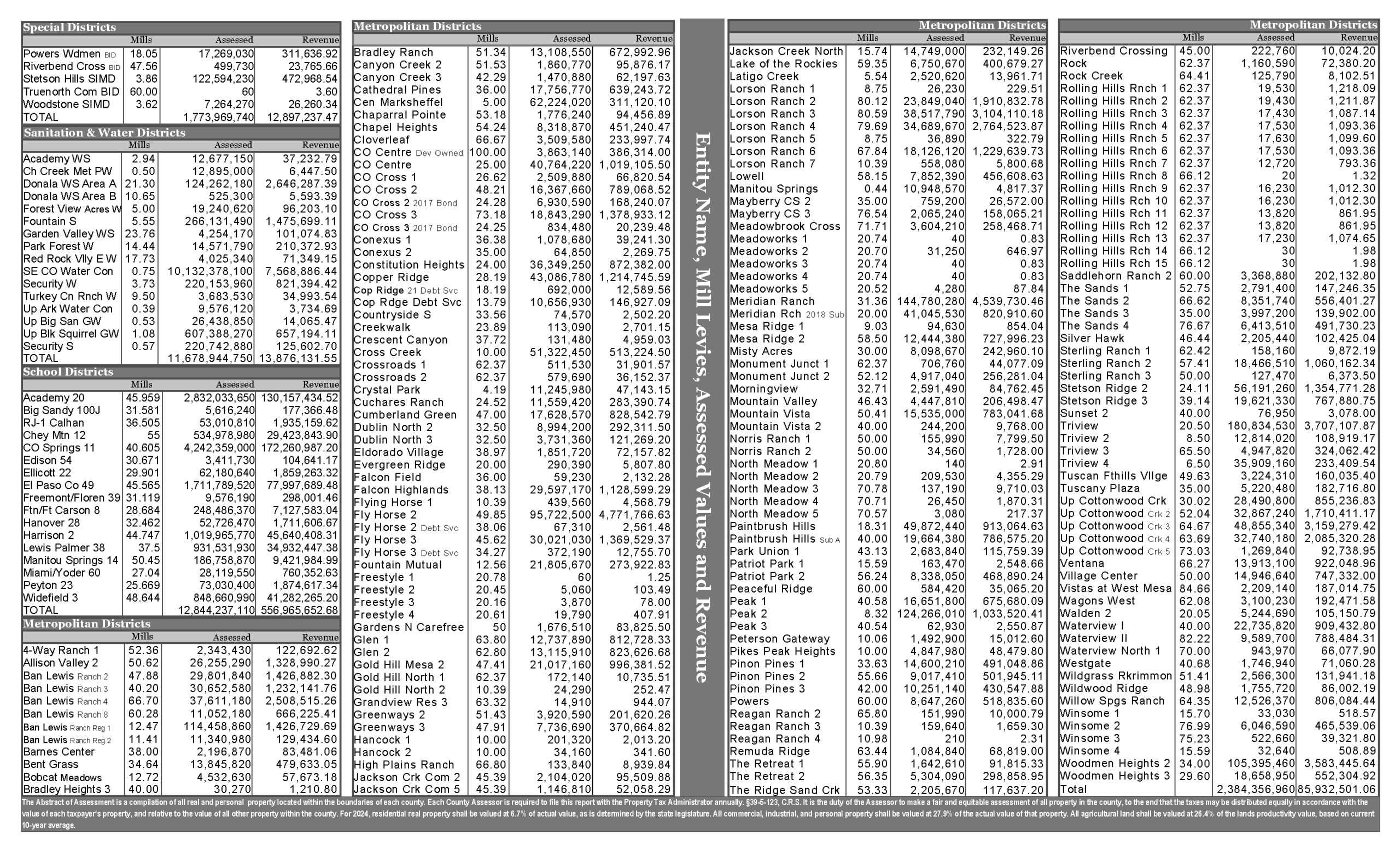
Disclaimer
The abstract is compiled and made available to you with the compliments of the El Paso County Assessor’s Office. We believe you will find it accurate and informative, regarding El Paso County property valuation.
Courteous answers and helpful assistance will always be provided by the Assessor’s Office to all questions and requests regarding the valuation of land, buildings, equipment, and fixtures. We encourage you to become knowledgeable about your assessments.
Important notices regarding valuation and taxes due are sent by mail to property owners each year. It is the responsibility of the property owner to provide the Assessor’s Office with correct mailing addresses for these notices.
To update or change your information, please email Asrweb@elpasoco.com
Questions?
Please contact us for additional information at:
El Paso County Assessor’s Office
1675 West Garden of the Gods Road
Suite 2300
Colorado Springs, CO 80907
(719) 520-6600